THE SCHIZOANALYSES
felix guattari
in
Soft Subversions
I needed your help to clarify my ideas. I noticed—and this is, incidentally, part of what I want to address here—that, in some situations, it was not possible to carry out such a clarification without the help of a collective assemblage of enunciation. Otherwise the ideas fall from your hands! As of quite some time now, I have been looking for a support polygon to define what has been running around in my head. I don't know if all of us here will constitute such a polygon.
We will soon find out! We had started to put one together, Mony Elkaim' and I, during previous discussions; only, it was in an episodic fashion, always "hurriedly," behind the scenes during meetings and symposia, where I was led to discuss systemist refer-ences in family therapy. But, until now, we hadn't really ever given ourselves the means to tie these questions to the critical work that I have undertaken, moreover, with Gilles Deleuze, on psychoana-lytic theory and practice.
What I am proposing today, after some clearing of the ground, after something of a "tabula rasa," is to find out what still stands amid the psychoanalytic rubble, what deserves to be rethought through the use of other theoretical scaffoldings, if possible less reductionist than those of Freudians and Lacanians.
I obviously hope that this seminar will allow for the most wide- ranging and open debates. But I have to warn you straightaway thatmy positions will sometimes be "debatable" only with difficulty. Not
/204
that I intend to impose them! But they will venture onto a territory that is, let's say, solitary, where it will be a bit difficult for me to make myself understood in an exhaustive manner. It goes without saying that at issue here is neither pedagogy nor scientific con-frontation, but exclusively the support for the work of each of us, of an assemblage of enunciation that should permit, if all goes well, to expand our respective processes of elucidation. With the hope that these will be subjected, along the way, to intersections, cross checks that will permit them to develop into a rhizome.
This seminar on "the schizoanalyses" will thus find its own scheme only if it itself begins functioning on a level that I would qualify as "meta-modelisation." Put in other words, if it allows us to better grasp our own assemblages of enunciation-although it would be better to say: the assemblages of enunciation to which we are adjacent. On this subject, I am eager to repeat that I have never conceived of schizoanalysis as a new special field that would be called to find a home in the psych. domain. Its goals should be, in my view, both more modest and bigger. More modest because, if it is to exist one day, it is because it already exists a little bit everywhere, in an embryonic form, under different modalities, and it has no need for an institutional foundation in due form. Bigger, inasmuch as it is cut out, in my view, to become a reading discipline of other systems of modelization. Not as a general model, but as a deciphering instrument of modelization pragmatics in numerous domains. One could object that the limit between a model and a meta-model does not always show up as a stable border. And that, in a sense, subjec- tivity is always more or less the work of meta-modelisation (in the view proposed here: transference of modelization, transversal passages between abstract machines and existential territories). The main thing is then a displacement of the analytic accent that consists in making it derive from systems of utterance and from preformed subjective structures, towards assemblages of enunciation capable of
/ 205
forging new reading coordinates and "bringing into being" new representations and proposals.
Schizoanalysis will thus be essentially off-center in relation to other professionalized psych, practices, with their corporations, societies, schools, didactic initiations, "pass," etc. Its provisional definition could be: the analysis of the effect (incidence) of assem- blages of enunciation on semiotic and subjective productions, in a given problematic context. I will come back to these notions of "problem- atic context," scene, and "bringing into being." For now, I will be satisfied to point out that they can refer to things as different as a clinical picture, an unconscious fantasy, a daytime fantasy, an aesthetic production, a micropolitical fact... The key here is the idea of an assemblage of enunciation, and of an existential circum- scription, which implies the deployment of intrinsic references-we could also say of a process of self-organization or singularization.
Why this return, like a leitmotiv, to assemblages of enunciation? In order to avoid getting bogged down, as much as possible, in the concept of the "Unconscious." In order not to reduce the facts of subjectivity to drives, affects, intra-subjective instances, and inter- subjective relations. Evidently, this sort of thing will have a place in schizoanalytic preoccupations, but only as a component and always in certain specific cases. We will observe, for instancee, that there are assemblages of enuciation not composed of semiological compo- nents, assemblages that do not have subjective components, others that do not have consciential components... The assemblage of enunciation will thus be led to "exceed" the problematic of the individuated subject, of the thinking monad consciously delimited, of the faculties of the soul (understanding, will...) in the way that they have traditionally been understood. I think it is important to underline straightaway that we will always be dealing with ensem- bles; at the beginning, equally material and/or semiotic, individual and/or collective, actively machinic and/or passively fluctuating.
/ 206
The question then becomes that of the status of these conpu- nents of assemblage, which find themselves thus "overlapping," between radically heterogeneous domains. I had said—1 no longer remember where-that we would like to construct a science where we could mix dust cloths and napkins' with other even more different things; where we couldn't even group dust cloths and napkins together under the same rubric, but where we would be ready to accept with good grace that dust cloths become differen- tiated through singular becomings, along with a procession of contextual repercussions, where we could be dealing with a bar owner drying glasses with a dust cloth, as much as with the military launching a "clean-up" (coup de torchon) on a pocket of resistance. From a classical psychoanalytic perspective, we only take this sort of contextuality into account in terms of its signifying effects, and never as a referent generator of pragmatic effects in the given social and material institutional fields. It is this micropolitics of meaning that seems to me to have been turned upside down. The presumed analytic effect no longer resides in a derivation of semiologically interpretable chains, but in an—a-signitying mutation of the "universal context," that is to say, of the constellation of the implicated registers of references. Collective and/or individual assemblages of enunciation are then not only full-blown objects of analytic investigation, but also equally privileged means of access to these objects, in such a way that the problematic of the enunciation transference starts, as a priority, on the problematic of imagos and structures allegedly constitutive of subjectivity. In a contingent manner, certain assemblages are put in the position of "analyzer" of the formations of the unconscious. It is of little importance if these analyzers are conscious of their "mission" or invested by other authorities in order to occupy this position. An analytic assemblage, under these conditions, can size itself differently, depending on whether it is embodied:
/ 207
— by an individual, Freud, for example, who invents psychoanalysis;
— by a sociologically delimited group, for example, a gang of youths that is "defined" by potentialities of a ghetto;
— by more diffuse social phenomena, such as mutations of collective sensibility or uncontrolled movements of opinion;
— by a pre-personal practice, a style, a creative mutation that engages an individual or a group without either him or it being aware of it.
(All of these scenarios, and many others capable of combining in multiple ways). Thus, the schizoanalytic approach will never limit itself to an interpretation of "given facts"; it will be interested, much more fundamentally, in the "giving" to assemblages that promote the concatenation of affects of meaning and pragmatic affects. As they also do not escape this general plasticity of assem- blages, the "analyzers" don't appear as pre-established systems; they never claim to institute themselves as legitimate structures of enun- ciation, as is the case with typical therapy. Not only because there will not be any normalized schizoanalytic protocol, but a new fundamental rule, an "anti-rule rule" will impose a constant putting into question of analyzer assemblages, in close relation to their feedback effects on the analytic data.
All of this feedback, which is negative when it leads to a simple rebalancing of the assemblage, and positive when it generates processes of splitting, if not catastrophes, makes up the analytic material par excellence. How does an assemblage take the relay of another assemblage in order to "manage" a given situation? How can an analytic assemblage, or so-called analytic assemblage conceal another? How do several assemblages enter into relationship and what becomes of it? How can we explore, in a context that seems utterly blocked, the potentialities for constituting new assemblages? How can we "help," if need be, relations of production, of proliferation,
208 / Soft Subversions
the micropolitics of these new assemblages? This is the sort of question that schizoanalysis will be asked to raise. This work of subjectivity-in the sense that we work iron, or up and down the scales of the piano, or that we work through the fruitful moments of existence in the Proustian "Remembrance" —is here identified with the production of a referent, or, more precisely, with a meta- modelization of trans-assemblage relations. Far from corresponding with what we ordinarily understand as subjectivity, it no longer relates to the supposedly subtle and ineffable essence of a subject in search of a vertiginous and impossible accord with itself, with God as sole witness. Schizoanalytic subjectivity is set up at the intersec- tion of sign fluxes and machinic fluxes, at the crossroads of facts of meaning, material and social facts, and, above all, of their trans- formations, resulting from their different modalities of assemblage. It is through the latter that it loses its aspect of human territoriality and is projected towards singularization processes that are both the most original and the most futuristic-animal, vegetables, cosmic becomings, immature becomings, multivalent gender, incorporeal becomings... By means of this subjectivity, without entirely ceasing to be a "thinking reed," man is currently adjacent to a reed "that thinks for him," to a machinic phylum that leads him well beyond his previous possibilities.
Archaic forms of enunciation rested mainly on speech and direct communication, whereas new assemblages increasingly resort to informative media fluxes that rest on increasingly machinic channels (the machines in question here are not exclusively of the techno- logical order, they are also scientific, social, aesthetic, etc.), which explode the old individual and collective subjective territories from all sides. Whereas territorialized enunciation was logo-centric and implied a personalized mastery of the ensembles that it discursivized, deterritorialized enunciation, which can be seen as
/ 209
machino-centric, leaves it up to non-human memories and proce- dures in order to deal with semiotic complexes that, to a large extent, escape a direct consciential control.
But we won't content ourselves with such a simple dichotomy, which would run the risk of being far too reductive. In view of the preceding considerations, we are already naturally led to decline a variety of modalities of assemblages of enunciation, depending on which components of semiotization, subjectivation, and conscien- tialisation happen to prevail or not (this list being always likely to expand, depending on descriptive needs).
—non-semiotic assemblages
The stigmergic constructions of bees or termites offer us our first example due to the extremely elaborate forms that they end up developing, based on "modular coding" which appears to be neither semiotic, nor subjective or consciential. With the case of human enunciation, similar systems, such as endocrinal systems of regula- tion, can be led to play a decisive roll within assemblages whose semiotic components they, to some extent, suspend. In particular, I am thinking of the likely role of an endorphine-based self-addiction in the "hardening" of certain sado-masochistic situations, or in acute forms of mental anorexia.
—non-subjective semiotic assemblages
For instance, the psychosomatic clinical pictures related to the "character armor" studied by Wilhelm Reich. Subjective representa- tions fall "to the side" of the somatic semiotisation.
–non-conscientized semiotic, subjective assemblages
For instance, assemblages pertaining to human ethology, which deal with processes of learning through unconscious stamps, delim- itations of territory, behaviors of welcoming, parade, submission, hostility, etc, I imagine that a Lacanian who had the patience to follow me until now, would certainly object that everything that I'm talking about is well and good but has absolutely nothing to do with
210 / Soft Subversions
the Unconscious, the true psychoanalytic unconscious, that we could not conceive of outside of the snares of language... We all know that song! To this, I would respond that schizoanalytic assem- blages have the most vital interest in reductionist structures of the oedipal triangle and symbolic castration sort, to which, in fact, a certain capitalization of subjectivity lead, in the context of what I would call capitalist subjectivity, except that this does not in any way exempt them from dealing with other productions of subjec- tivity in all the domains of psychopathology and anthropology, and with respecting their specific characters. In this sense, the claim of schizoanalysis, is really, I repeat myself, to set itself up as the meta- modelizing assemblage of all these heterogeneous domains that it will treat as so much "optional subject matter." Our point of depar- ture will thus be the most extensive hypothesis, that of the existence, for man, of an unconscious domain that puts on an equal footing facts of meaning supported by structures of representation and language and systems on an equal footing-all very different from each other—of coding, modeling, tracing, imprinting... related to organic, social, economic, etc. components. Bringing the phenom- ena of subjectivation into play, that is, the establishment of lived territories, taken on as such in a relation of delimitation with an objectal world and alter egos, will only be occasional, optional. In other terms, neither the question of the subject, nor that of the linguistic signifier will necessarily be at the center of the problematics posed in this unconscious domain. The same holds for the question of the conscience, Various processes of conscientialisation following and/or superimposing themselves on each other can be brought into play here. In order to illustrate these sorts of connections (branchements) and disconnections (débranchements), a good exam- ple is provided by the driving of cars. It is not out of the ordinary, on the highway, for a person to start daydreaming in a pseudo- somnolent state? In reality, the subject is not sleeping; he is allowing
The Schizoanalyses / 211
many conscious systems to function at the same time, of which some are toned down and others suddenly become of primary importance. This is what happens when a road signal, an accident, or a passenger speaking up, makes the driver switch back to a state of hyper-vigilance. The assemblage of enunciation, in the enlarged sense I am giving it here, thus travels through several levels of machinic enslavement (asservissement) (to use an already old notion from cybernetics). Thus, instead of constantly returning to the same supposedly founding structures, to the same archetypes, to the same "mathemes," schizoanalytic meta-modelization will instead prefer to map (cartographier) the compositions of the unconscious, continent topics, in their connection to social formations, technology, arts, sciences, etc. Even when it will happen to bring to light some unconscious scenarios, based, for instance, on ego-organizing, per- sonological, conjugalist, familialist, or domestic formulas, it will never do it, I repeat, with the aim of defining a structural prototype.
Let's pause to consider some of the implications of the "split-off" (décollage) between the conscience and subjectivity in the manner in which we have started to consider it. I initially thought that it would be necessary to differentiate between:
— an absolute unconscious, at a molecular level, which would radically escape all representations and whose expressions would belong solely to the field of a-signifying figures; 4
— a relative unconscious at a molar level, which would set itself up, on the contrary, in more or less stable representations. I then became afraid of falling prey, for my part, to a topical paralysis of psychic instances like the one that led Freud to separate the Unconscious and the Conscious (linked to the Pre-Conscious) into opposing sides and then, later, the Id and the Ego (with its attendant elements), or which led Lacan to erect a symbolic order as the framework of the Real and the Imaginary.
/ 212
Already, upon first examination, the denomination "molecular unconscious" appears shaky. In fact, this type of assemblage is perfectly capable of putting up with the existence of consciential components. The molecular processes that are at work in a hysteric or obsessive neurosis are inseparable from a particular type of consciousness and even hyper-consciousness, with respect to the latter. An oneiric or a delirious assemblage, while operating from an a-signifying material-all of which doesn't prevent it from conveying as well images and signifying chains, but from them it only holds on to what it can treat as a-signifying figures— themselves consist of modes of idiosyncrastic conscientialization. I don't think that we would have anything to gain from hoping to equip all of these instances with a single consciential essence that would be always self-identical. Gradually, we come to borderline-states of con- sciousness, with mystic experiences of rupture with the world, with catatonia, or even—why not-non-localizable organic tensions or more or less deep comas. And thus, all the instances of enunciation can be concurrently conscious and unconscious. It's a matter of intensity, of proportion, of reach. There is no consciousness or unconsciousness that isn't relative to incorporeal Universes of reference which authorize composite assemblages, superimpositions, slippages (glissements), and disjunctions. And we sense, that on their tangent, must exist an absolute conscience which could coincide exactly with our absolute consciousness, constitutive of a non-thetic presence to oneself, apart from any reference to alterity or society.
X: But is this absolute unconscious biological?
Félix Guattari: Yes, among other things!
J-C. P.: I was wondering if-with regard to this machinic molecular aspect you weren't returning to what you attributed to desire a few
/ 213
years ago? To something, really, thoroughly heterogeneous, chaotic, rhizomatic, etc.; whose digitalization-whose markings, if you like, by means of linguistic-type code-would release what Lacan calls the unconscious. That which allows him to say—to himself, but also to those who are working under him with psychotics—to say that "schizophrenia doesn't have an unconscious." Is it, in some sense, the same partition that is drawn between what is held in the folds of a signification or significance system and what isn't, i.e., everything else, the essential?
Félix Guattari: There is something in the way in which you for- mulated your question that bothers me a little. I'm not invested in reestablishing an opposition between the primary process and secondary elaboration, above all if this opposition has to be founded—as in the second Freudian topic (Id, Ego, Superego)— on the idea that the passage from the one to the other would correspond to a change of levels of the different modes of differ- entiation, with chaos on the side of the primary process and structuration on the side of the secondary. This is not—as, in fact, you emphasize-because we don't have a digitalized, binarized access to the molecular unconscious, that we, for all of that, sink together with into a world of irremediable disorder and entropy.
This brings me back to the issue of desire. Yes! It's true that I want to escape today from a number of misunderstandings of, let's say, the economic order, in the sense in which Freud under- stood it and which developed after Anti-Oedipus around ideas such as flux and break of flux (coupure de flux). In fact, we nev- ertheless stressed the deterritorialized machinic dimensions of desire, which escaped the habitual ensemblist coordinates (thus our insistence on paradoxical categories such as the Body With- out Organs). But this way of presenting desire was perhaps not sufficiently demarcated from the idea of "flat," territorialized
214 / Soft Subversions
fluctuations, authorizing references to an economy in equilibrium, shut off in itself.
Moreover, this would be one of the principal objectives of this seminar to attempt to clarify how this category of deterritorialization can prevent us from transforming notions such as those of subjec- tivity, conscience, signification (signifiance)... into transcendental entities impermeable to concrete situations. The most abstract and the most radically incorporeal references are in direct connection with the real; they travel through the most contingent fluxes and territories. They are in no way safe from historical influences or cosmogenetic mutations. In short, the signifier does not transcend the libido. (We could, with respect to this, easily show how Lacan progressively substituted that one for this one ). In some contexts, meaning can be massively opposed to material and signaletic Auxes that are conceived of as essentially passive. However, in other contexts, meaning can originate following a "machinic" of fluctua- tions that has broken loose (really or potentially) from the strata and homeostasis. It is this processual option, this refusal of a generalized economy of equivalences, this choice of the "clinamen," that led us to challenge fixed cartographies, the unvariables by right in the domain of subjectivity-even when they in fact appear in certain areas of assemblage, as is the case with oedipal triangulation in the field of capitalistic production.
We thus decided not to consider situations other than through the angle of crossroads of assemblages (carrefours d'agencements), which secrete, up to a certain point, their own coordinates of meta- modelization. Admittedly, a crossroads can impose connections, but it is not a fixed constraint; it can be bypassed, it can lose its con- nective power when some of its components lose their consistency. Le's try to illustrate this point. A singer loses her mother. The following week she also loses two octaves of her range; she starts to
/ 215
sing out of tune, her interpretive gifts seem to suddenly go to the dogs. This woman's singing was set up at the intersection of multi- ple assemblages of which the majority, of course, go beyond the domain (circonscription) of her person. The enunciation component that grafted itself onto her relationship with her mother underwent the trial of death. All of this is in no way synonymous, far from it, with her extinction. In fact, the unactual part of herself-the past that one can't return to-having taken first place over that part of herself open to possibilities, a representation of her mother, erratic and vaguely menacing is put into circulation. This image of death, sheltered from any reality test, brings about petrification. As Freud wrote, the subject clings to the lost object." In this particular case, however, the only manifest consequence of this semiotic "contrac- tion" seems to confine itself to the vocal part of the musical activity. It is conceivable that a more dogged exploration would have revealed other effects. But was such an investigation absolutely nec- essary? It's not clear, because in cases like these, we must always fear "inventing" new symptoms after the transference and the interpre- tation, either by exaggerating the elements of an etiological tableau which seems to "fit well" or, which often amounts to the same thing, when the subject himself brings you the suitable symptoms on a platter. In this case, it's a matter of keeping oneself clear of the temp- tation to root "the work of mourning" in a difficulty, for the libido, to find itself an object of substitution. Here as elsewhere, the description in terms of object, rather than in terms of assemblage of enunciation, presents the major disadvantage of prohibiting the shedding of light on fields of non-programmed possibilities. Where Freud saw only two options— either the slow and melancholy liqui- dation of the libido invested in the lost object, or, in the case of an extreme fixation, a "hallucinating psychosis of desire"' —we should be ready to welcome reorganizations of assemblage escaping without complex the curses of primary identification or the relation of "oral
216 / Soft Subversions
incorporation." And it is precisely what has happened with this singer who, if you allow me the expression, stood firm (encaissé le coup), conquering even, on this occasion, several new degrees of liberty and putting herself from now on in control of her superego in clearly a much more flexible manner. The loss of consistency of a component will not have been followed, this particular time, by a chain reaction of new inhibitions. It will instead have served as a sensitive plate, as a developer, as an alarm bell. But of what exactly? That is precisely the question! To which, actually, it is best not to answer too quickly. As there is perhaps no answer to it, strictly speaking. An a-signifying sign-the restriction on vocal perfor- mances-marks the halt of something without forbidding, as the context makes clear, that other things intervene. Great! This is already something! Certain paths marked out for a long time: singing, the moralizing surcoding of the mother, are experiencing a pragmatic transformation. Should these facts be considered liabilities and put down in record in the column of lacks and deficits: Nothing is less certain! But nothing is determined either! As a lot of things can depend on this inscription. It must be clear that all transferential induction, even the most subtle, the most roundabout, which would give us to assume the existence, behind this symptomatic manifestation, of a guilt of oedipal origin could have devastating effects or, at the very least, bring us back to the depressive tableau which is "normally" expected under such circumstances. It seems less risky to me to think about the material qualities of this compo- nent of expression, which perhaps allowed her to avoid further damage. Is it because of the presence of such a "luxurious" compo- nent that the song did not allow a preventative alarm to be raised and to suggest a bifurcation? From then on what was called to vegetate under the guise of inhibition was transformed into the beginning of a singularization process.
/ 217
X: Do you think that, without the song, something else could have occurred? Félix Guattari: Maybe she would have lost other types of octaves, in other sorts of registers! But nothing can be depended on in this domain. Everything here is a matter, I repeat, of the threshold of consistency, transformation quanta, of the possibility of concurrent effects. Some of the mother's facialist traits (traits de visagéite) broke free from her face, deterritorialized from the coordinates of the superego, in order to work on their own behalf, along other lines of possibilities, other universe constellations. Their surveillance frowns got stuck on the extremes of the scale where they found a sort of altar on which the sacrificial offerings would not be too costly. But perhaps this sort of description, which has more in common with the myths and the tales of the Gourmantche or the Warlpiri, is less secure than the framing, within "pre-fabricated" intra-psychic systems, of typified complexes and structuralized instances?
J-C. P.: Are you thinking about theories of hysteria?
Félix Guattari: Yes, of course! We could bring out the famous "pha- ryngeal lump," the "appearances and disappearances" of Kleinian objects, the rupture of identification consecutive to melancholic introjection and—why not?—the desintrication of the death drive.
J-C. P.: Ultimately, what you are saying is that you would like to leave open the possibility, not to interpret, but to articulate ditter- ently planes as seemingly far apart from each other as the concrete phonological voice, the musical voice as abstract fact and, for example, the family structure. This would involve venturing the hypothesis about completely different connections than those that we were able to imagine until now.
218 / Soft Subversions
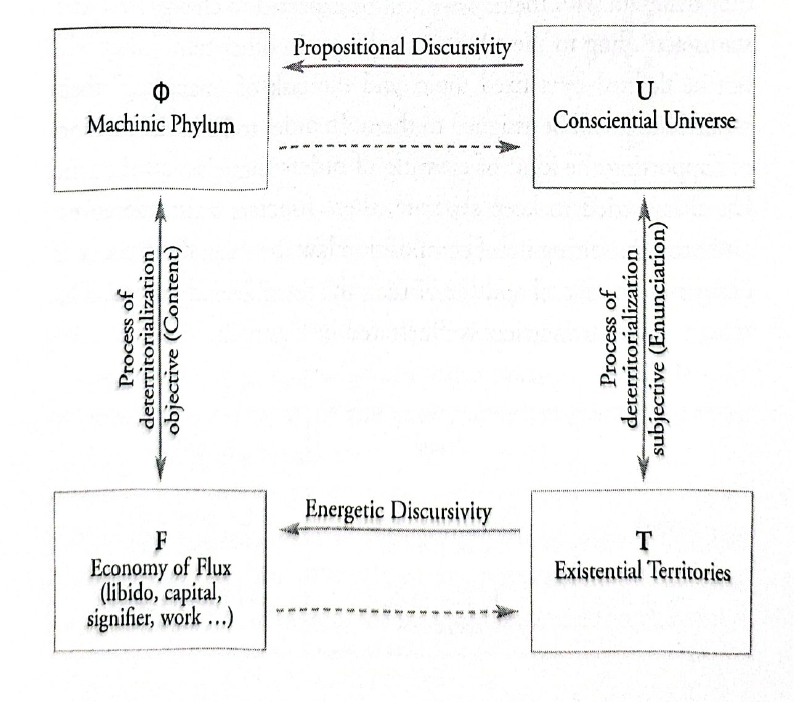
The category of deterritorialization should thus allow us to sepa- rate the problematic of consciousness-and, as a consequence, of the unconscious-from the representation of the ego and the unity of the person. The idea of a totalizing, indeed totalitarian, consciousness ("I am master of myself as of the universe") takes part in a foundational myth of capitalistic subjectivity. In truth, there are only different processes of conscientializtation, resulting from the deterritorialization of existential territories which are themselves numerous and tangled up with each other. However, in their turn, these different instruments for forging a for-itself (pour-soi) and singling out a relation to the world distinct from the in-itself (en-soi) and alter egos, will not be able to acquire the consistency of an existential monad, unless they manage to express themselves on/through/by means of(?) a second dimension of deterritorialization that I would describe as energetic discursivation. Here we come to the following schema, which, to a certain degree, anticipates points that we will only address later.
/219
Four functers F.T.Ф.U., through the means of their relations of reciprocal presupposition (indicated in abscissa) and of their rela- tions of composition (indicated in ordinate) exhibit four domains:
— material and signalectic Flux
— existential Territories
— abstract machinic Phylum
— incorporeal Universes (qualified as consciential in this particular case)
By relying on these, we hope to succeed in creating a cartography of the configurations of subjectivity, of desire, instinctual energy, and of the different modalities of discourse and consciousness related to them, without further recourse to traditional systems of somatic infrastructure, instinctual basis, determinism founded on need and lack, behavioral conditioning, etc. To that end, entities pertaining to these four domains will not have a permanent identity. They will only support their own configurations through the relations that they maintain with them. They will be expected to change state and status according to the whole assemblage. In other terms, they will not be defined by a fixed topic, and the task of "managing" their modelization will be assigned to them. In order to be in the position of supporting the kind of crossing of orders that classical thought has always tried to keep separate, these functers must, moreover, authorize the setting up of composition laws between the two sets of categories, the actual and the virtual, the possible and the real. The crossing of their matrices is illustrated in Figure 2:
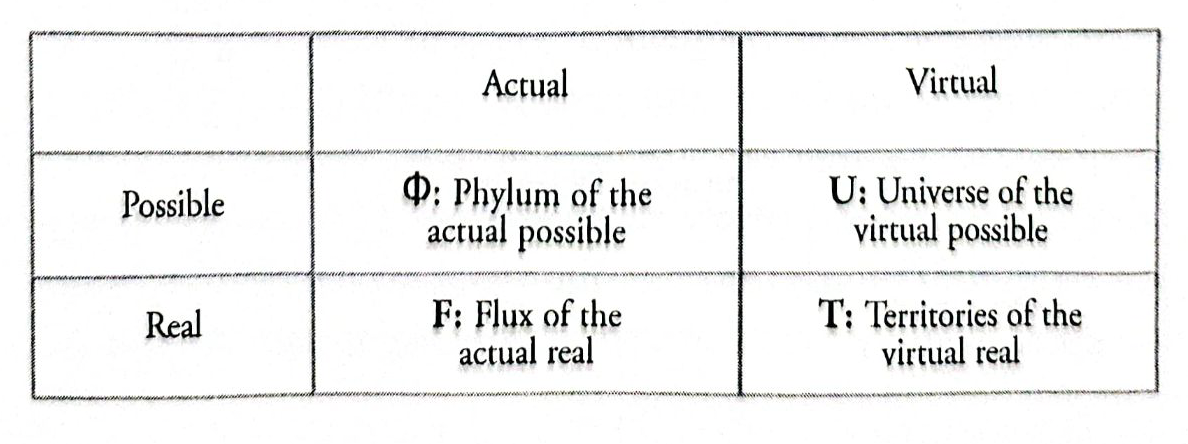
/ 220
All the while keeping in mind considerations to come, we put for- ward, from the present moment, that the relations of inter-entitary presupposition coming into scope inscribe themselves according to the coordinates of objective and subjective deterritorialization, will not be able to maintain the Flux and the Territories of the real on an equal footing with the Phylum and the Universe of the possible-the latter two envelop and subsume the former, so much so that the real of the possible prevails over the possible of the real. In these condi- tions, the Phylum will constitute, in a way, the integrals of the Flows and the Universes, the integrals of the Territories. (Fig. 3).
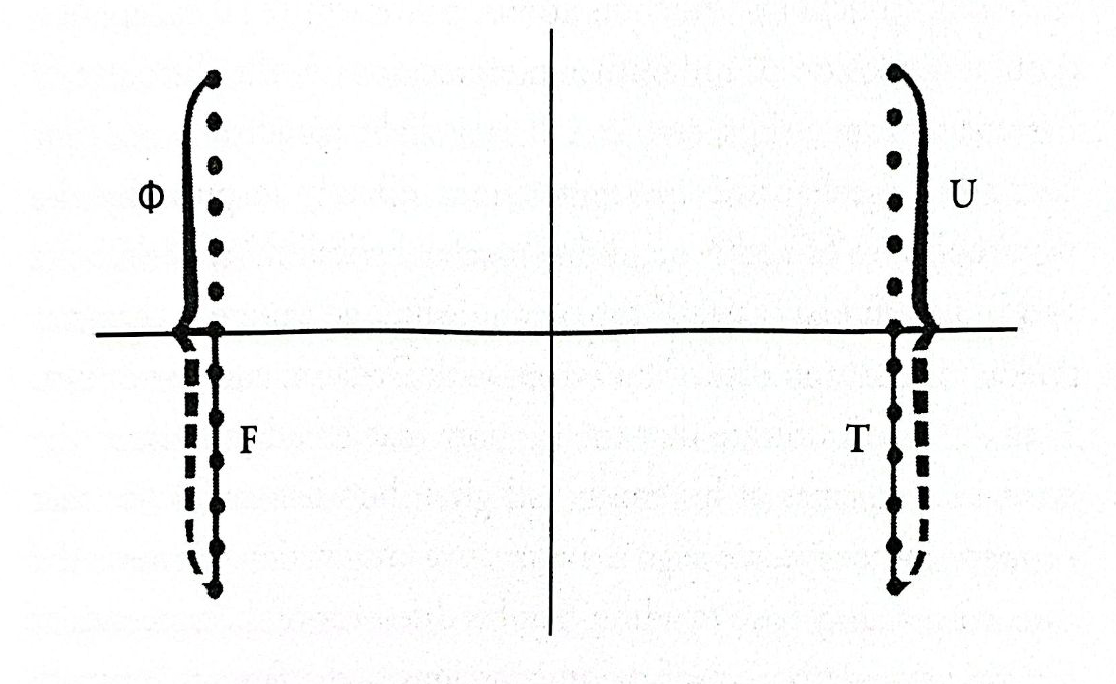
But haven't we thus secretly reestablished relations of transcendence between the possible and the real? Not really, insofar as, as we will soon establish, a synaptic game of extension of the assemblages in the sense of deterritorialization will leave open the possibility of a permutation of position of the constitutive entities of signifying realities and signified possibles,
Although it is always tricky to venture into the domain of Freudian filiations— the majority of psychoanalysts, for over fifty years now, having claimed authority from the work of Freud as if from a revealed
The Schizoanalyses / 221
text—it doesn't seem like a useless exercise to try to locate how the present attempt to refound the unconscious on deterritorialization takes its place within these filiations, and how it differs from them. Freud's first concern was to make psychology scientific by introducing abstract quantities into it.' It is this preoccupation that will disorganize the lawful ordering of the "faculties of the soul" of classical theories and bring about a deterritorialization of the psyche ending up in the promotion of an unconscious "scene," illocalisable within its ordinary phenomenological coordinates. However, while we could have expected that such an intrusion in the psychism would have had an essentially reductionist function, it was, conversely, the corollary of a genuine explosion of innovative interpretations of the discourse of hysteria, dreams, slips, wit, etc. It is a slight paradox to see thus coexisting mechanistic presuppositions directly inspired by the psychophysics of Fechner and the "psychophysicalism" of Helmholtz and Brüke, and an "abyssal" exploration whose adventurous character will have hardly an equivalent except with Dadaism and Surrealism. It all seems to indicate that the support that Freud took from the scientistic schemas of his epoch had given him self-confidence that allowed him to give free reign to his creative imagination. However the case, we certainly have to admit that his discovery of the processes of semiotic singularization of the unconscious —the famous "primary process" —would have quite a bit of difficulty in finding a home in the rigid associationist context that he was developing concurrently in the wake of his Project for a Scientific Psychology of 1895. Yet never did he cut off his connection with his initial neuronic models. (He will, for example, in the final edition of the Traumdeutung of 1929, hold onto his first reflexological professions of faith, with the conse- quence that the Unconscious and the Preconscious continue to find themselves sandwiched between perception and motricity).
The result of Freud's incessant comings and goings between an impenitent scientism and a lyric inventivity reminiscent of
/ 222
romanticism, is a series of reterritorializations carried out in reaction to the numerous projections of deterritorialization of the psyche. Here I will mention this phenomenon only with respect to a couple of concepts: that of the libido and that of the Unconscious.
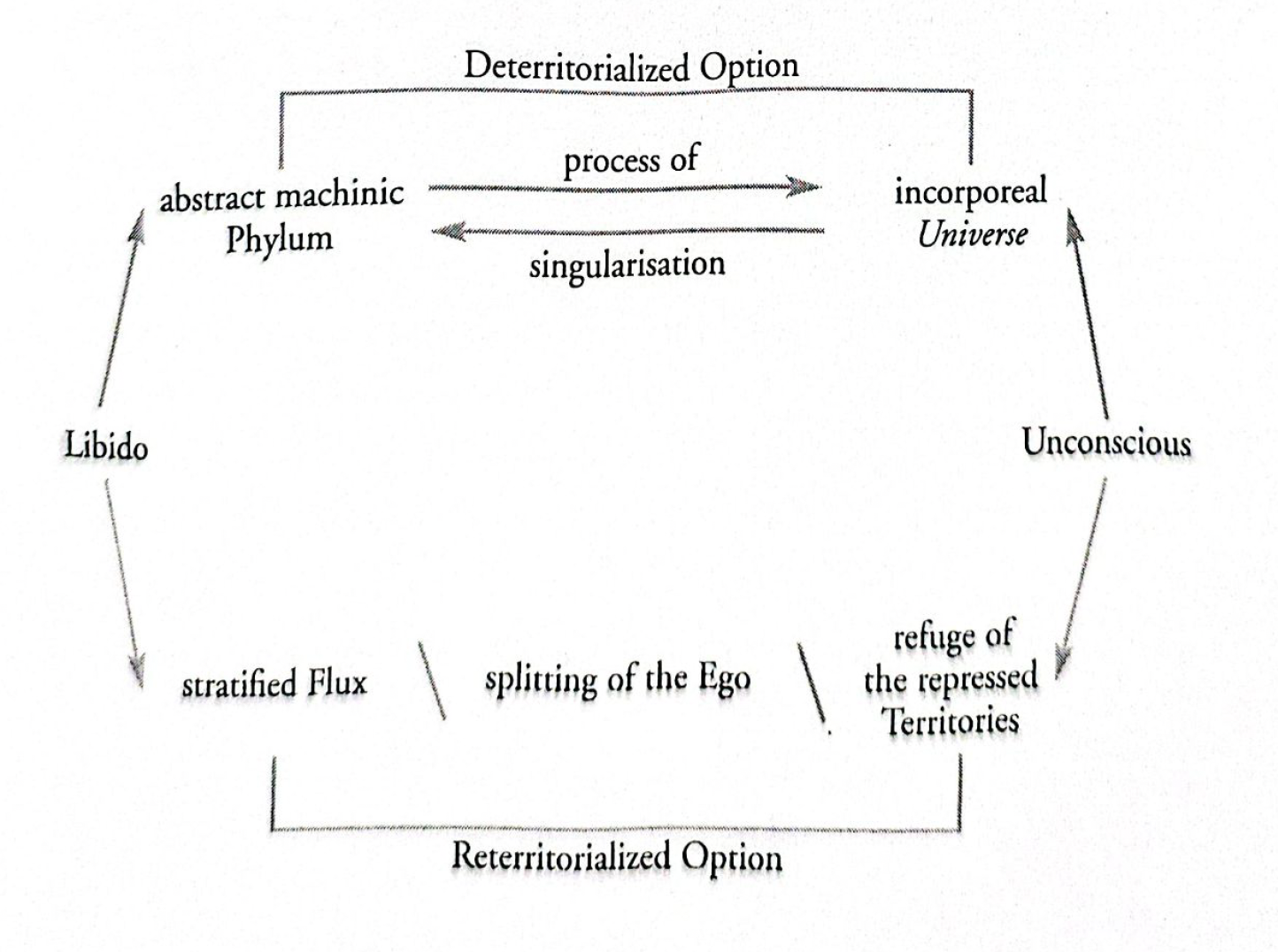
The libido can be given two statuses: one of a processual energy that diverts heterogeneous systems far from their equilibrium, or that of a static energy working towards the stratification of psychic formations. Freud never succeeded in binding them together, even when he postulated the coexistence of an object libido and an Ego libido. We see things differently from our perspective; these two sta- tuses cannot pertain to the hazards of an economic balance such as he proposed, but to fundamental micropolitical choices. The libido will thus find itself "denatured," deterritorialized; it will become a sort of abstract material of the possible. The generic choice will become either the deterritorialized option of the schizoanalysis of a libido-phylum (on the left axis in Figures 1 and 3) as integral of the transformational flows of desire (material and signaletic), either the reterritorialized option of a libido-Flow Freudianism, forming cysts first of all in the somatic part of drives (the thrust and the source, in contrast with the goal and the object), then put into psychogenetic stages in order to finally be left the prisoner of an intemporal face to face with an entropic death (Eros-Thanatos opposition).
For the unconscious, the generic choice will be: either to constitute itself as a Universe of reference of new (inédit) and unprecedented (inouis) lines of alterity, of possibles and becomings (on the right axis of Figures 1 and 3), or to be a Territory-refuge for the repressed, held in check by the censor (in the Conscious-Preconscious system of the first topic) and by the Ego-Superego system (in the second topic).
Very early on, Freud left the first terrain to theoriticians like Jung who, by the way, hardly knew how to make use of it. On the other hand, he never stopped reterritorializing the Unconscious in different ways:
/ 223
— on the spatial plane, as I just said, he circumscribed it by means of an instance which, in his second topic, that of the Id, finds itself emptied of all substance, reduced to an undifferentiated chaos.
— On a temporal plane, where with his discovery of the unex- plored continent of infantile sexuality, he succeeded in the feat of conferring an historic dimension to the Unconscious discourse all the while removing from it the knowledge of the passing of time, and managed to outsmart the realist implications of the memory of the traumatisms of precocious seduction by territorializing them and by converting them into fantasmatic refrains (ritournelles), he lost all that he had gained, if I might say so, by reterritorializing the stages of libid- inal maturation, and by periodizing a psychogenesis in a rigid fashion.
— Same reversal of situation with regard to the object of desire. At the time of the Traumdeutung, the object of desire appears in an ambiguous and rich manner. Like Albertine in Proust, "a many- headed goddess," (and probably a goddess of many genders as well), once again he escapes, to a certain extent, the binary and phallic capitalistic logics. For example, the Irma of the inaugural dream of the Traumdeutung is described as a "collective person" who gathers together a "generic image."—the patient who is in question in the dream;-another woman that he would prefer to treat;-his own eldest daughter;—a child who is under his care at the hospital; —yet another woman;— finally, Madame Freud, in person ... Elsewhere, we will see that "localities are often treated as people." The object can then function as a "knot" of overdetermination, the "umbilic" of the dream, the "point at which it is linked to the unknown," and from which he makes lines of singularization proliferate. Deterrito- rialization will still gain some new ground through the exit of the libidinal object from its personological context in order to become "partial." From this point on, the door was open for other becom- ing: non human, animal, vegetable, cosmic, abstract machinic becomings... But the door was at once closed to all possible and
/ 224
imaginable ways, an exhaustive and typified list of the partial objects in question having been drawn up and made to serve as normative landmarks along the "obstacle course," which every subjectivity wishing to rise to the supreme stages of "oblative genitality" is supposed to get through, and as Freud's successors, with their "bad" and "good objects," and by moving from "object relations" to "cran- sitional objects," then to objects "a," ended up turning the partial object into a general function stripped of all traits of singularity.
— The same goes for alterity, which Freud had nevertheless introduced as a requirement of truth in the most carefully guarded psychopathological pictures. In which it will also find itself reterri- torialized by becoming prohibited from staying in the preoedipal relations supposedly fusional and structuralized into an initiatory complex of symbolic castration under the menacing eye of the Sphinx, and later transformed into the matheme "A" by Lacan.
To sum this up, the two "optional subject matters" of the Libido-Unconscious encounter/face-to-face could be represented in the following fashion:
/225